Look beyond the words enclosed garden
A garden can be enclosed without being suitable for every dog. Ask about its edges, gates and shared access before treating it as a deciding feature.
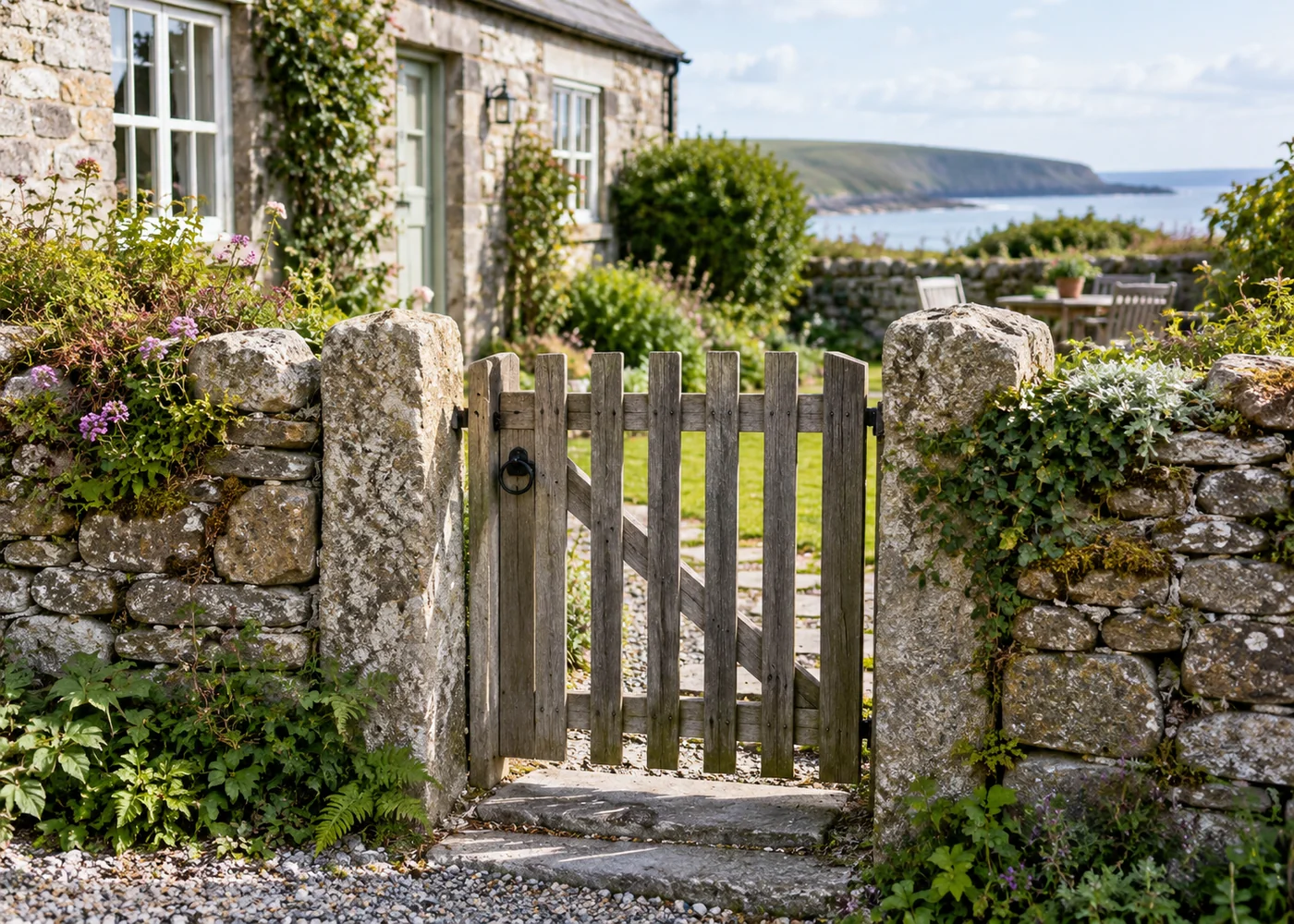
Picture the whole perimeter
The useful garden photograph is not always the prettiest one. A close view of the patio may leave the rear hedge, side passage and entrance gate outside the frame. Ask for a view of each boundary when the garden is important to your booking. You are trying to understand one continuous perimeter, including the places where different materials meet. A solid wall on three sides does not explain what closes the fourth.
Ask what the boundary is made from and how its height varies. A hedge can look dense in summer and have openings near the ground. A wooden fence may step down beside a slope. Walls sometimes meet outbuildings at an angle that creates an unexpected gap. The answer does not need to sound reassuring; it needs to be specific enough for you to compare with the dog you know.
Measurements are more helpful than adjectives. A host's idea of a high fence may differ from yours, and a small dog may notice spaces that a larger one would ignore. Explain the practical concern without asking for a guarantee: for example, whether there are gaps below the gate or whether the side passage connects to the parking area. These questions are straightforward for an owner to check and less ambiguous than asking if the garden is secure.
Understand how people use the space
Find out whether the garden belongs solely to the cottage. A shared lawn, access to neighbouring accommodation or a route to bins changes how you use it. Someone else may open a gate without knowing your dog is outside. Even a private garden can have planned maintenance visits. Ask who needs access during the stay and whether there are agreed times, then make a simple plan for keeping the dog with you when needed.
Check the relationship between doors and outdoor space. French doors may lead directly to an enclosed section, while the kitchen door opens onto an unfenced drive. A garden reached across a lane is a different arrangement again. Look at the route rather than just the existence of a lawn. If the household includes children or several adults, everyone needs to know which door can be opened and what should happen before it is.
Gates deserve their own question. Is there more than one? Does a pedestrian gate sit beside vehicle access? Does the latch close reliably, and is the lower edge clear of the ground? These are observations to confirm with the host and inspect on arrival, not an invitation to alter fittings. If a closure appears damaged, tell the host and use another arrangement rather than improvising a repair that others may not understand.
Make the arrival check with your dog beside you
Do the first circuit before allowing any freedom in the space. Keep your dog controlled while you look along the ground, behind outdoor furniture and around sheds. Check for changes since the photographs were taken, such as a moved panel or a gap beside new landscaping. A quick inspection can establish how you will use the garden, but it cannot make it escape-proof or remove the need for supervision.
Notice what lies beyond the boundary. Livestock, a busy road, a neighbouring dog or frequent foot traffic can affect the choice even when the fence looks substantial. You may prefer to spend garden time together on a lead rather than relying on the barrier. For some dogs, a quieter property with a modest outdoor area will work better than a larger garden facing a constant stream of distractions.
Keep the booking decision realistic
Consider whether you would still enjoy the stay if the garden needed supervised use throughout. If the answer is no, seek more information before paying. A host cannot reasonably certify a space for every animal, and an attractive listing should not be treated as a substitute for your own judgement. Choose accommodation whose limitations you understand rather than a description that leaves you guessing.
Pack whatever ordinary equipment you already use safely, but do not plan to install temporary fencing or attach a long line to cottage structures without agreement. Those solutions may be unsuitable for the layout or property rules. It is often simpler to use the garden as a pleasant place to sit together, with familiar short outings elsewhere, than to make the success of the holiday depend on unrestricted outdoor access.