Choose family bedrooms by layout rather than headcount
The number of beds tells only part of the story. Look at how bedrooms connect, who uses each one and what happens after the lights go out.
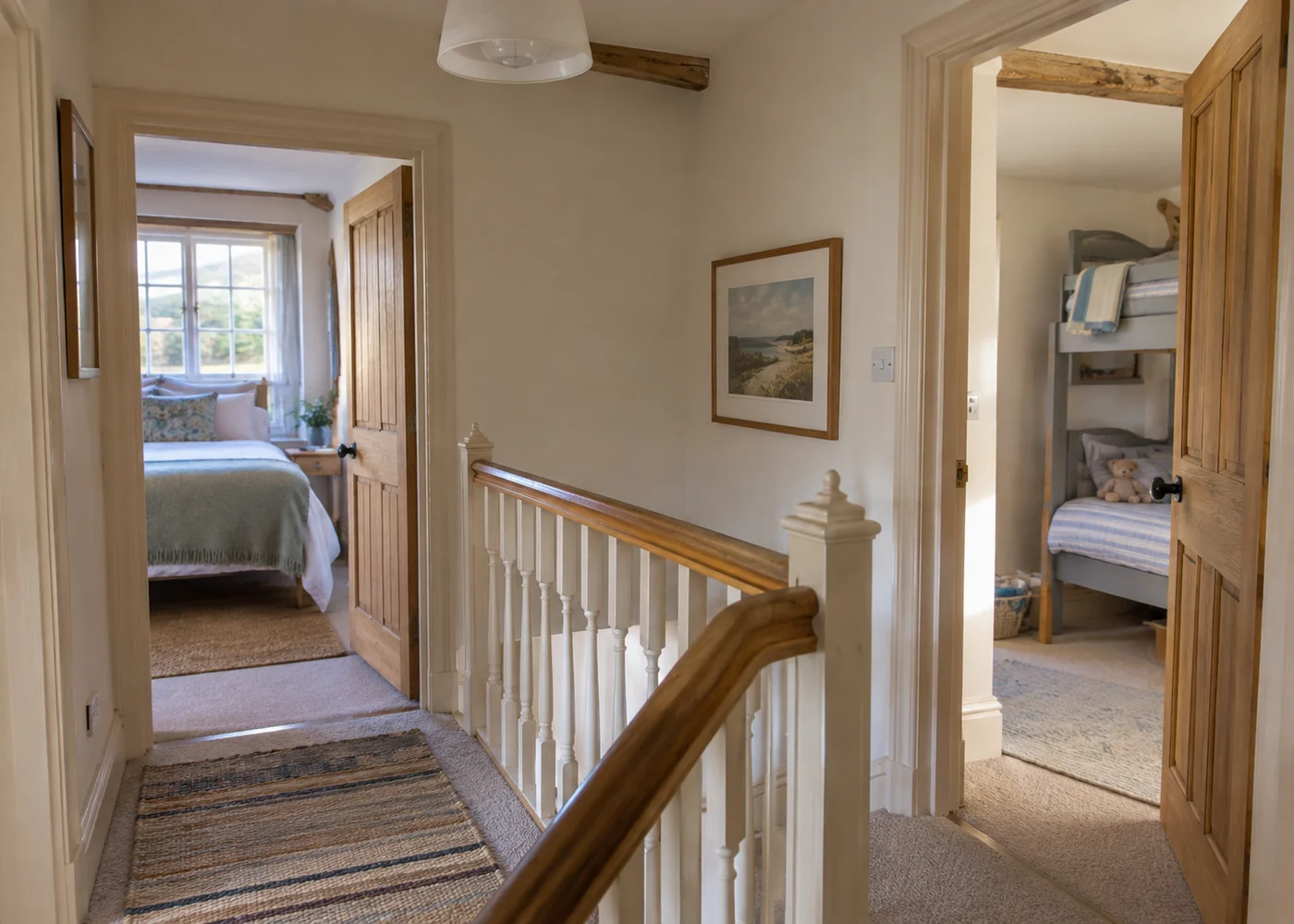
Begin with people, not the advertised capacity
A cottage described as sleeping six might have three conventional bedrooms, a sofa bed in the sitting room or a sleeping space reached through another room. Those arrangements offer very different evenings. Write down who is travelling and the sleeping arrangements they actually need. Do not count a bed as suitable merely because somebody could physically fit in it for a few nights.
Ask for the floor plan if the photographs leave the layout unclear. Look at which rooms are upstairs, which share a landing and whether any are separate from the main house. A bedroom in an annex can be attractive for adults seeking privacy but unsuitable for the role you had in mind for younger children. The relevant issue is the relationship between rooms, not whether each one looks comfortable in isolation.
Check whether beds can be configured differently and whether that must be requested in advance. Two single beds shown pushed together may not mean the room is routinely offered as either a twin or a double. Confirm the actual arrangement for your booking. If someone needs a particular bed size or position, ask directly rather than estimating dimensions from a wide-angle photograph.
Follow the evening routes
Imagine an adult moving from the sitting room to a child's bedroom, or someone going to the bathroom overnight. Are there stairs, a connecting room or a door to outside? Does the route pass through the only quiet sleeping space? These are practical questions rather than reasons to reject every unusual cottage. An old building can work well when you understand the layout and choose room allocations accordingly.
Notice noise as well as distance. A room immediately above the kitchen may be affected by early breakfast preparation, while a bedroom opening onto the sitting room changes how late others can stay up. Ask about the layout rather than requesting a guarantee of silence. Families have different routines, and the best property for yours may be one with a modest separation between sleeping and social spaces.
Consider the final use of a sofa bed. If it occupies the main living room, someone will need to pack bedding away each morning or accept losing the room during the day. The person sleeping there may also be the last to bed and first to get up. Agree whether that is fair and comfortable before booking, especially for a longer stay. Capacity on a listing is not the same as an arrangement everyone will enjoy.
Check the details that affect your family
For younger children, ask about the relevant facilities and follow appropriate safety guidance for the child's age and needs. Do not assume a travel cot, stair gate or other item is supplied, suitable or compatible with the layout simply because the property is described as family-friendly. Confirm what is available and the manufacturer's or professional guidance that applies, rather than improvising with furniture after arrival.
For older children and teenagers, discuss privacy and sharing openly. A twin room may be welcome for siblings on one trip and awkward on another. There is no universal age at which a particular arrangement becomes right. Ask the people involved before deciding, within the practical limits of the budget, and avoid making promises about separate rooms until the booking is confirmed.
Think about belongings. Suitcases need somewhere to go without blocking the route around a bed. A small bedroom with ample drawers may work better than a larger room whose floor is taken up by spare furniture. Look for usable storage and enough clear space for the routine you expect. You do not need wardrobes for a two-night stay, but you do need to reach the door without stepping over bags.
Allocate rooms before arrival
Once you know the layout, agree the rooms in advance. Explain choices in practical terms: proximity, access, quiet or bed configuration. Avoid a race to claim the most attractive room as people unload. If an arrangement involves a compromise, make sure the affected person understands it and that the compromise is reasonable for the length of the stay.
Keep the first evening flexible enough to notice a genuine problem. A lamp may be positioned differently from the photograph, or a connecting door may change how the room feels. Raise property issues with the host and make simple permitted adjustments where useful. Do not move heavy furniture or disable fittings to make the original plan work.
After one night, a small change to the household routine may solve more than a change of room. Preparing breakfast later, storing bags elsewhere or keeping a corridor clear can make the layout easier to use. The important work happened before booking: choosing a house whose sleeping spaces fit your family well enough that the remaining details are manageable.