Read the rooms between the listing photographs
Accommodation photographs are good at showing individual rooms. Your job is to work out what connects them and what remains outside the frame.
Start with the ordinary views
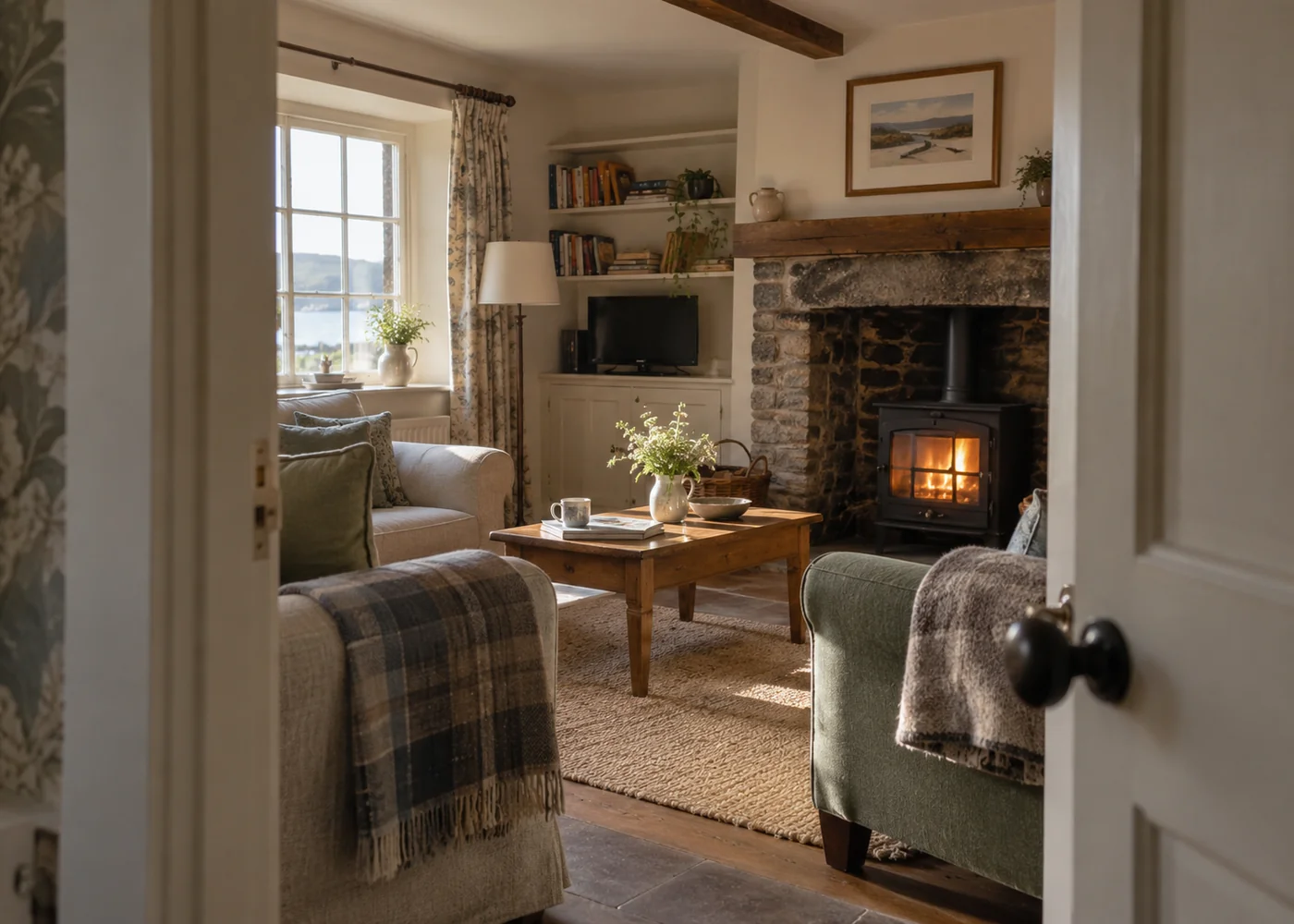
Enjoy the attractive details, then return to the wider photographs. A vase, a folded blanket or a close-up of a fireplace adds atmosphere but says little about usable space. Look for views that show doors, windows, furniture and routes together.
Count the main rooms described in the text and see whether each appears. A missing photograph is not proof of a problem, but it is a reason to ask about a space that matters to you. This is particularly useful for smaller bedrooms, shower rooms, entrances and stairs, which can have a large effect on everyday comfort.
Notice when several images show the same room from different angles. A generous gallery can create the impression of more space than it actually documents. Match obvious features such as windows and fireplaces so that you understand the room once rather than unconsciously counting it several times.
Reconstruct a simple route
Imagine entering with a bag of groceries. Where is the kitchen in relation to the door? Can you reach the sitting room without passing through a bedroom? Does the garden connect directly to the house or require a route around the building?
The aim is a rough understanding, not a precise architectural reconstruction. When the relationship between spaces is unclear, ask for a floor plan or a description. Photographs cannot reliably establish dimensions, and apparent distances change with the camera position and lens.
Look at doors visible in the background. They may lead to a useful utility room, a locked cupboard or another accommodation unit. Do not invent an answer. Make a short note of anything that could affect privacy or movement, then ask about it directly.
Pay attention to the edges
The edge of a photograph often contains the practical information: a radiator, a narrow gap beside a bed, a step down to the patio or the only available plug socket. These details help you frame questions, although they should not be treated as a complete inspection.
In kitchens, identify actual working surface rather than simply admiring a long counter. In sitting rooms, count comfortable seats. In bedrooms, look for luggage space and a route around the bed. Each room needs a different test because each has a different job.
Outdoor photographs require the same care. A close view of a garden may omit the shared path or nearby building. Ask for a wider view when privacy, boundaries or access are important. An image of countryside somewhere in the gallery may illustrate the area rather than the view from the cottage, so read its caption.
Use the text to challenge the image
Compare what you see with the written description. If the text says the property sleeps six but the table is laid for four, there may be an extension or extra chairs. Ask rather than assuming either a shortfall or a solution. If a room appears upstairs, confirm whether the bathroom is on the same level.
Look for statements about decorative features, seasonal facilities or items not included in the booking. A photographed fire may not be usable; outdoor furniture may vary. The current listing and a clear reply from the manager are more useful than a guess based on an attractive scene.
If a feature is essential, keep the written confirmation. This is especially worthwhile for a required bed configuration, a particular appliance or a step-free route. A saved photograph alone may not communicate the condition you thought you were booking.
Stop when the practical questions are answered
There is no need to analyse every cushion or search for hidden faults. A gallery is a presentation of a property, not an invitation to mistrust it. The useful response is a small set of focused questions about the parts that affect your holiday.
When the answers and images fit together, move on to location, timings and the group's plans. A cottage does not need to be perfect in every frame. It needs to be understandable enough that arrival feels like meeting the place you selected, rather than discovering how much your imagination supplied between photographs.